

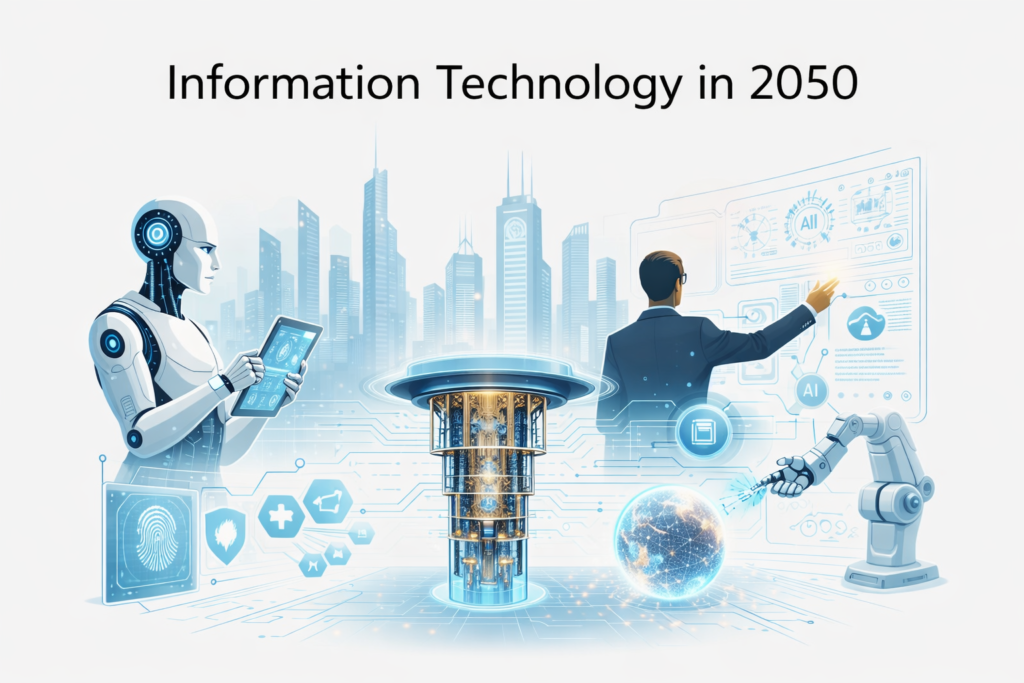
Information technology is evolving faster than any other field in human history. From artificial intelligence and cloud computing to quantum systems and immersive digital realities, IT is reshaping how we live, work, and think. By 2050, information technology will not just support human life — it will deeply integrate with it.
This article explores what will happen in 2050, the technologies shaping that future, and the famous companies actively building tomorrow’s IT ecosystem.
Introduction to Information Technology
Information technology refers to the use of computers, networks, software, and data systems to store, process, and exchange information. Today, IT drives nearly every industry — from finance and healthcare to transportation and entertainment.
As we move toward 2050, information technology will no longer be a background system. It will become a core foundation of human civilization, enabling intelligent decision-making, automation, and global connectivity at an unprecedented scale.
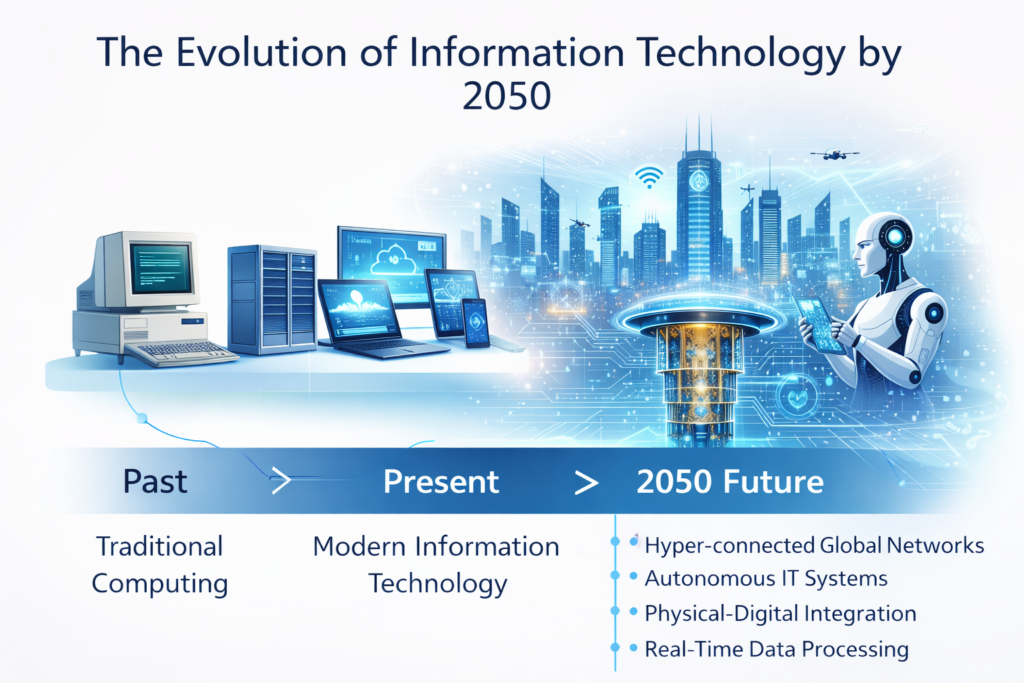
The Evolution of Information Technology by 2050
By 2050, information technology will evolve into a fully intelligent, self-optimizing ecosystem. Traditional computing models will give way to adaptive systems that learn, predict, and respond in real time.
Key developments expected:
- Hyper-connected global networks
- Autonomous IT systems with minimal human input
- Seamless integration between physical and digital worlds
- Real-time data processing at massive scale
Information technology will become invisible yet omnipresent — embedded in homes, cities, workplaces, and even the human body.
Artificial Intelligence and Automation in 2050
Artificial intelligence will be the backbone of information technology in 2050. AI systems will evolve beyond task automation to become context-aware, emotionally intelligent, and ethically guided.
Expected impacts:
- Fully autonomous businesses and factories
- AI-driven decision systems in governments
- Personalized digital assistants managing daily life
- Human-AI collaboration in creative and scientific fields
Information technology powered by AI will dramatically increase productivity while redefining employment and skill requirements.
Quantum Computing and Advanced Data Processing
Quantum computing will revolutionize information technology by solving problems impossible for classical computers. By 2050, quantum systems will process massive datasets in seconds, transforming industries like pharmaceuticals, climate science, and finance.
Key benefits include:
- Ultra-fast data encryption and decryption
- Breakthroughs in medical research
- Accurate climate and space simulations
- Advanced machine learning models
Quantum-based information technology will redefine what computing power truly means.
The Future of Cybersecurity and Digital Privacy
As information technology grows more powerful, cybersecurity will become more critical. By 2050, digital identity protection and data privacy will be managed by AI-driven security frameworks.
Future cybersecurity trends:
- Self-healing networks
- Biometric-based authentication
- Decentralized identity systems
- AI-powered threat detection
Information technology will aim to create trust-based digital ecosystems where security is proactive, not reactive.
Information Technology in Healthcare, Education, and Smart Cities
By 2050, information technology will deeply transform essential human services.
Healthcare
- AI-assisted diagnosis and treatment
- Predictive health monitoring
- Personalized medicine using genetic data
Education
- Virtual and augmented learning environments
- AI tutors adapting to student needs
- Global access to quality education
Smart Cities
- Intelligent traffic and energy systems
- Automated waste and water management
- Real-time city monitoring using IoT
Information technology will improve quality of life while promoting sustainability.
Famous Companies Working on Future Information Technology
Several global companies are actively shaping the future of information technology for 2050:
Google (Alphabet)
- Artificial intelligence and quantum computing
- Advanced data analytics and cloud infrastructure
Microsoft
- Cloud-based information technology platforms
- AI, cybersecurity, and enterprise automation
IBM
- Quantum computing leadership
- Enterprise-grade AI and data solutions
Apple
- Human-centric information technology
- Augmented reality and wearable computing
Amazon (AWS)
- Scalable cloud computing
- AI-powered information technology services
Tesla and NVIDIA
- Autonomous systems
- High-performance computing and AI hardware
These companies are laying the foundation for next-generation information technology ecosystems.
Challenges and Ethical Considerations
Despite its promise, information technology in 2050 will raise serious ethical and social questions:
- Job displacement due to automation
- Data ownership and surveillance risks
- AI bias and decision transparency
- Digital inequality across regions
Responsible development of information technology will require global cooperation, regulation, and ethical frameworks.
Final Thoughts: The World Shaped by Information Technology in 2050
By 2050, information technology will redefine human potential. It will enhance intelligence, connectivity, and sustainability while reshaping economies and societies. The future will belong to those who understand, adapt to, and ethically guide the power of information technology.
The journey toward 2050 has already begun — and information technology is leading the way.